 blog
Is Smart Lighting Control Worth It for Retail Shops?
Quick Summary
Smart lighting control is worth it for retail shops with irregular opening hours, daylit areas, or zones that sit empty for long periods. It is less likely to pay off in a small shop with steady hours and already efficient fittings. Payback depends on your current lighting cost and how much of the day the lights run unnecessarily.
- Controls cut running hours and output, while LED upgrades cut wattage per fitting; they compound.
- Calculate payback as installed price divided by annual saving, using your actual lighting cost.
- Ask quotes to separate the LED saving from the control saving and state their baseline assumptions.
- Use occupancy sensors in back rooms and storage, not on the shop floor where customers stay still.
- Check controller compatibility, firmware updates and data security before buying.
Table of Contents
- What Smart Lighting Control Actually Adds to a Shop
- Upfront Cost, Payback Period and Long-Term Savings
- Comparing Smart Controls, Basic LED Upgrades and Conventional Lighting
- Occupancy Sensors for Shops: Where They Pay Off and Where They Do Not
- Daylight Harvesting in Retail and Dimming for Merchandise and Customers
- Retail Lighting Control Systems: Interoperability, Security and Data
- Deciding for Your Shop and Booking a Lighting Review with BVI
- Frequently Asked Questions
What Smart Lighting Control Actually Adds to a Shop
Smart lighting control is a system that switches, dims and schedules the lights in a shop automatically, usually from a central controller or app. For retail shops, it answers a simple question: are the lights doing useful work when nobody needs them? Most shops would say no, at least some of the time.
The value comes from the things a system like this can do that a wall switch cannot. Such systems can run lights to opening hours, reduce output in quiet periods, respond to daylight coming through windows, and detect whether anyone is in a given area. Each of these can cut waste in a different way.
Smart controls can also provide usage data, such as when a zone is lit and how many hours fittings run each week. That visibility can matter more for a multi-site retailer than for a single shop.
Upfront Cost, Payback Period and Long-Term Savings
Upfront cost is where most retail lighting decisions stall, so it is worth breaking the figure down rather than treating it as one number. A smart control installation generally involves a few cost components: the controllers and gateways, the sensors and dimming modules, the installation labour, and any software or subscription fee for a cloud platform. The overall cost depends on the scope of the work and the platform chosen.
Because pricing depends on fitting count, control type, wiring condition and whether the lights are already LED, request a written quote against your own layout from BVI Building Services & Controls Ltd for current prices.
Payback is the time it takes for energy and maintenance savings to repay the outlay. You can estimate it with three numbers: your current annual lighting cost, the share of that cost the controls can plausibly cut, and the total installed price. Divide the price by the annual saving to get the years to payback.
A worked version makes the logic concrete. Consider a shop whose lighting accounts for a known share of the electricity bill, and whose installed control price is known. The annual saving is the current lighting cost multiplied by the plausible reduction, and payback is the installed price divided by that saving. The two variables that move the answer most are how much of the day the shop is empty or daylit, and how much the lights are left running today.
A total-cost-of-ownership view is more honest than a hardware price. Over a ten-year horizon, add the hardware, the installation, any annual software fee, maintenance and replacement of sensors and drivers, and the electricity at your current rate. Compare that total against the same calculation for a basic LED upgrade and for doing nothing. The controls usually win on running cost but lose on upfront cost; the question is whether the gap closes within the period you are prepared to wait.
Savings claims that bundle LED and control savings into one figure can overstate what the controls alone deliver, so ask for the two effects to be separated in any quote or proposal.
Maintenance is the quiet line item. Occupancy sensors and dimming drivers have finite lives, and in a retail environment they are exposed to dust, heat and cleaning. A control system that is cheap to buy but needs frequent sensor replacement can erase its energy saving. Ask the installer what the expected replacement cycle is and whether the components are standard enough to source locally.
Comparing Smart Controls, Basic LED Upgrades and Conventional Lighting
Retail lighting advice often bundles LEDs and controls together, which can make it hard to see what each option actually delivers. The three options solve different problems, and separating them is the single most useful thing a shop owner can do before committing.
| Option | What it changes | Main saving source | Upfront cost pattern | Best suited to |
|---|---|---|---|---|
| Conventional lighting | Nothing | None | Lowest upfront, highest running cost | Very low usage, short-term budgets |
| Basic LED upgrade | Replaces lamps or tubes | Lower wattage per fitting | Moderate upfront, no software fee | Shops wanting a quick, low-risk improvement |
| Smart controls | Adds scheduling, dimming and sensing | Less running time and lower output when not needed | Highest upfront, possible software fee | Shops with irregular hours, daylight or empty zones |
The key distinction is that an LED upgrade reduces the power drawn per fitting for every hour the light is on, while controls reduce the number of hours and the output level. They compound, but they are not substitutes. A shop that installs controls on old fluorescent fittings still pays fluorescent wattage whenever the lights are on; a shop that installs LEDs without controls still runs them when nobody is there.
A like-for-like comparison therefore needs a common baseline: the same shop, the same opening hours, the same electricity rate, and the same measurement period. Against that baseline, the LED upgrade delivers a saving proportional to the wattage reduction and is largely independent of how the shop is used. The control saving depends entirely on usage, it is largest where the shop is empty or daylit for long periods, and close to zero where the lights are already switched off manually and the shop is fully occupied all day.
For many shops a sensible order is LED first, then controls if the numbers justify it, since controls on inefficient fittings save a smaller absolute amount. A shop with irregular hours, large windows and back-room areas that sit empty may be a strong candidate for both. A small shop with long, steady hours and already efficient fittings may find controls add cost without much benefit.
Watch out: a proposal that quotes a single payback figure without stating the baseline equipment, opening hours and electricity rate cannot be checked. Ask for those assumptions in writing before you compare quotes.
A practical way to test the comparison is to ask the installer for two payback figures, one for the LED upgrade alone and one for the controls added to it, using your actual bills and opening pattern. If the controls-only payback is longer than you are prepared to wait, the LED upgrade is the better first step, and the controls can be revisited later when the fittings are already efficient.
Occupancy Sensors for Shops: Where They Pay Off and Where They Do Not
Occupancy sensors switch lights off when an area is empty. They can suit back rooms, storage areas, toilets, staff rooms and some corridors, where people come and go in short bursts.
On the shop floor they are less reliable. Customers standing still browsing, or a shop assistant working at a till, can trigger a false "empty" reading and leave the lights off. Shoppers can find that unsettling and it can make the store feel closed. Sensors on the shop floor need careful tuning and testing before you rely on them.
As a rule, use occupancy sensors where people move through and leave, and avoid them where people stay still for long periods. Test them during normal trading hours before committing to a full installation.
Daylight Harvesting in Retail and Dimming for Merchandise and Customers
Daylight harvesting means dimming artificial lights when natural light is enough. A shop with large windows can save energy on sunny days, but only if the sensors are placed sensibly and the dimming responds gradually rather than jumping suddenly. Sudden changes can be jarring for customers.
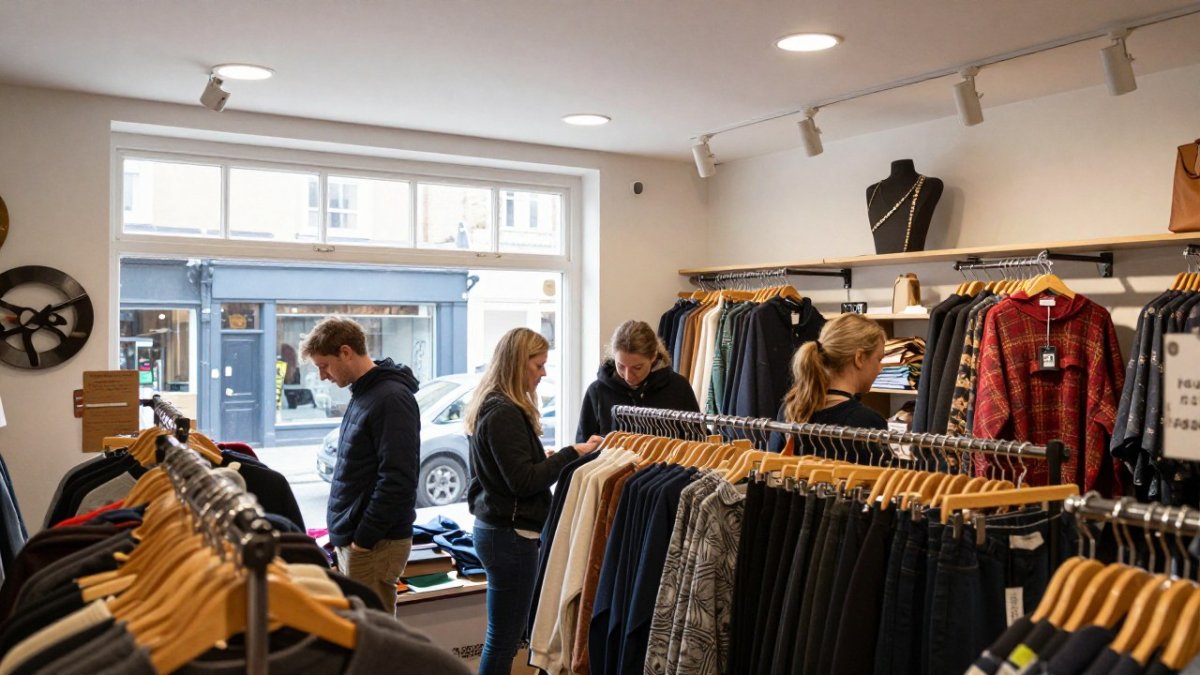
Dimming is also a merchandising tool. Lower light levels can make a window display or a feature wall stand out less, so dimming should be tied to zones, not the whole shop. Keep the lighting on products and at the entrance steady, and dim the less important areas. Check colour rendering too, since heavily dimmed LEDs can shift how clothes and food look.
Retail Lighting Control Systems: Interoperability, Security and Data
Before buying, check that the controller works with the fittings you have or plan to install. Some systems need specific drivers or proprietary components, which can lock you in. Ask whether the system uses an open protocol, how firmware updates are delivered, and whether the controller is connected to your network.
Connected controls bring security duties. Change default passwords, keep the software updated, and place the controller on a segregated network if possible. Lighting data about when the shop is occupied can also reveal trading patterns, so ask how that data is stored and who can access it.
For multi-site retailers, a single platform across shops simplifies monitoring and maintenance. For a single shop, a simpler standalone system may be enough.
Deciding for Your Shop and Booking a Lighting Review with BVI
Smart lighting control is worth it when your shop has irregular trading hours, meaningful daylight, zones that sit empty for long periods, or a need for remote monitoring across several sites. It is less likely to pay off in a small shop with long, steady hours and already efficient fittings.
If you are unsure, start with a review of your current lighting, electricity use and opening pattern. BVI Building Services & Controls Ltd can assess whether smart control suits your shop and provide a written quote. To arrange a review, contact BVI Building Services & Controls Ltd and describe your premises, or read the controls audit guide to see what the assessment covers before you book.
Frequently Asked Questions
How much can smart lighting controls reduce a retail shop's energy use?
Savings depend mainly on how many hours the lights run and how much of that time they are lit for no reason, such as empty aisles, back rooms or daylit areas. Controls that switch off unused lighting, dim lights near windows and schedule lights around opening hours can reduce lighting energy use noticeably, but the figure varies by shop. The most reliable way to estimate your own saving is to measure current lighting hours and wattage, then model the reduction a control plan would achieve before committing to a system.
How long does it take for smart lighting controls to pay for themselves?
Payback depends on the upfront cost of the controls, the electricity your shop uses for lighting, and how many hours the lights currently run unnecessarily. Where lights are on for long hours and controls cut that time substantially, payback can be reasonable, but where lighting is already LED and run for short hours, payback may be long. Pricing depends on the number of fittings, zones and system type, so request a site-specific quote from BVI Building Services & Controls Ltd before estimating payback.
Are smart lighting controls worth it for a small shop?
They can be, but small shops usually have fewer fittings and shorter operating hours, which reduces the savings available. A small shop with a single room, good daylight and simple opening hours may get more value from a basic LED upgrade with timers or manual dimming. Smart controls tend to make more sense where a shop has multiple zones, long hours, varied occupancy or a need to control light levels for merchandise presentation.
Do occupancy sensors save energy in shops?
Occupancy sensors save energy where lit areas are regularly empty, such as stockrooms, toilets, fitting rooms and quieter aisles. They are less useful in a busy sales floor where people are present most of the time. Sensor placement, detection range and the time delay before switching off all affect results, so the sensor set-up should be checked against how your shop is actually used.