 How-to
Why Building Trades Coordination Matters
Table of Contents
- What Building Trades Coordination Means
- Why Coordination Affects Project Success
- Construction Coordination Drawings and Design Coordination
- Trade Stacking in Construction and Work Sequencing
- Building Services Coordination: Communication and Daily Management
- Construction Site Productivity and Efficiency Gains
- A Practical Coordination Workflow and Responsibility Matrix
- Frequently Asked Questions
Last Updated: October 16, 2026
What Building Trades Coordination Means
Building trades coordination is the process of synchronising work across multiple construction trades, electricians, plumbers, HVAC technicians, gas engineers and others, so each knows what the others are doing, when, and how their work connects.
At its core, coordination prevents one trade from blocking another: an electrician shouldn't run cables where the plumber needs pipework, and HVAC shouldn't schedule work while the electrical crew is still fitting control systems. In isolation, delays and rework multiply quickly.
Building trades coordination involves shared planning, clear communication and agreed sequencing, with someone, typically the general contractor or a dedicated coordinator, holding all the information and deciding who works when and where. Without it, trades arrive unprepared, discover conflicts mid-project, and pay for expensive fixes.
Why Coordination Affects Project Success
Poor coordination is one of the fastest ways to blow a construction budget and timeline.
Poor coordination also drives rework and waste: materials get damaged or installed in the wrong sequence, quality suffers as trades rush to make up time, and safety risks rise in crowded, unplanned conditions.
The financial impact is real: a twelve-week project stretches to sixteen, labour costs rise, material waste climbs, and subcontractors charge extra for schedule changes and idle time.
Poor coordination also affects the final building's performance.
Coordination also protects safety. On a congested site without clear sequencing, crews trip over each other's materials, temporary installations aren't secure, and hazards go unnoticed because communication is fragmented.
Construction Coordination Drawings and Design Coordination
Construction coordination drawings are the visual language that keeps trades aligned.
Without coordination drawings, clashes emerge during construction: an electrician finds the HVAC duct occupies the cable route, or a plumber finds a structural beam blocking the main water line. Work halts, someone redesigns on the fly, and quality drops.
Coordination drawings catch these conflicts in the design phase, when changes cost almost nothing: moving a duct route on paper takes minutes, on a live site days and money.
Design coordination also ensures systems integrate properly: sensors match HVAC zones, electrical panels sit where they're accessible, and plumbing routes avoid structural elements.
Many projects skip this step to save time or money upfront. The savings evaporate on site. Coordination drawings prevent far more expensive problems than they cost to produce.
Trade Stacking in Construction and Work Sequencing
Trade stacking occurs when multiple trades work in the same space at the same time, competing for room, access and resources. A small area crowded with electricians, plumbers and HVAC technicians slows work, harms quality and multiplies safety risks.
Proper work sequencing prevents stacking by determining which trades work when. The sequence should flow logically:
- Structural and building envelope work completes first
- Rough-in phases follow (electricians, plumbers, HVAC running initial lines and conduits)
- Coordination between trades happens during rough-in, this is when conflicts are resolved
- Final connections and testing occur after rough-in
- Finishing trades come last
The sequence depends on the project: some work runs in parallel, while other tasks must finish first. A plumber can't test water lines until the electrician has powered the pump, and an HVAC system can't be balanced until all ductwork is in place.
Poor sequencing creates bottlenecks: if the electrician isn't finished when the plumber arrives, the plumber waits or works in a cramped, unsafe area, and trades needing the same ceiling space interfere.
Effective sequencing also considers resource availability: schedule scarce skilled electricians when they can make maximum progress without waiting, and adjust around delayed materials so other work continues.
Building Services Coordination: Communication and Daily Management
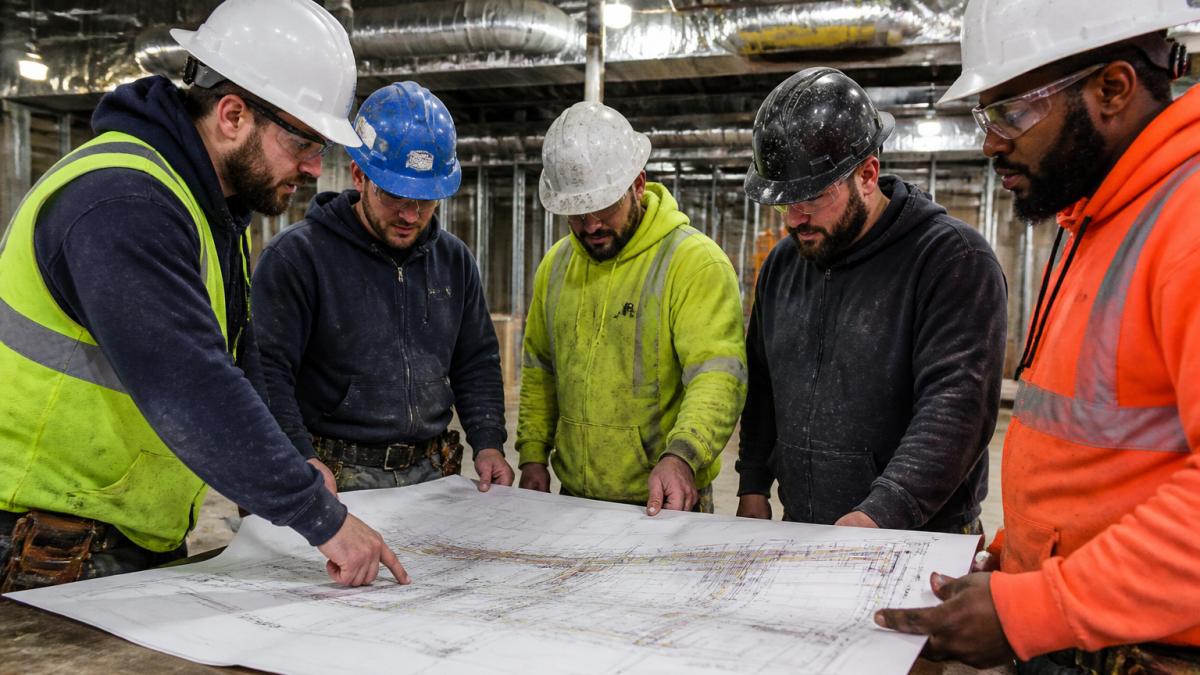
Communication is where coordination lives or dies. Without a structured rhythm, trades drift out of sync, assumptions replace facts, and conflicts emerge too late to fix cheaply.
The four-layer communication rhythm
Most well-run sites operate four distinct communication layers, each with a different cadence and audience:
- Daily site huddle (10-15 minutes, start of shift). The coordinator briefs trade leads on the day's plan, flags dependencies, confirms materials and access, and captures any new constraints. Output: a one-page daily plan posted at the site board and shared digitally.
- Weekly coordination review (60-90 minutes). Trade leads and the coordinator walk the next two weeks of work, resolve emerging clashes, confirm resource availability, and lock the sequence for the coming week. Output: an updated look-ahead schedule and a refreshed issue log.
- Monthly commercial and programme review. Commercial leads, the principal contractor, and trade leads reconcile progress against the programme, review variations, and address any cost or resource pressures before they become disputes. Output: a revised programme and a variation register.
- Event-driven escalation. When a conflict, design change, or safety issue can't be resolved at the daily or weekly layer, it escalates to a named decision-maker within an agreed timeframe (commonly 24-48 hours). Output: a documented decision with an owner and a date.
What good communication actually produces
Every layer should generate a written artefact, not just a conversation. The artefacts that matter most are:
- A look-ahead schedule covering the next two to six weeks, showing which trade is in which zone and when.
- An issue log (sometimes called a constraint register) listing every open clash, RFI, or dependency, with an owner and a target resolution date.
- A decision log recording who approved what, when, and on what basis, essential if a variation is later disputed.
- A daily site diary capturing labour on site, weather, deliveries, and any instructions given.
Without these artefacts, coordination depends on memory and goodwill. With them, it survives staff changes, holiday cover, and the inevitable week when three trades all need the same riser.
Tools that support the rhythm
Digital tools don't replace the rhythm, they make it auditable. Common combinations include:
- A common data environment (CDE) for drawings and models, so every trade works from the current revision. Under ISO 19650, information should be shared through a CDE with clear status codes (work in progress, shared, published, archive).
- A clash detection and issue-tracking platform (for example, tools built around Navisworks or Solibri outputs) where clashes are logged, assigned, and closed out with a timestamp.
- Mobile field tools so site staff can raise an issue, attach a photo, and tag the responsible trade from a phone rather than waiting for the next meeting.
- A shared programme (often a cloud-hosted Gantt or a 4D model linked to the schedule) so trade leads can see how their work interacts with others in real time.
Clear ownership beats good intentions
Beyond meetings, coordination requires unambiguous decision rights: who decides when a conflict arises, who approves sequence changes, who tracks progress and flags delays.
Communication isn't just about meetings. It's about creating a shared understanding of the project's goals, constraints, and progress. Trades that understand the bigger picture make better decisions and coordinate more effectively.
Construction Site Productivity and Efficiency Gains
Coordination directly improves productivity, but only if you can measure it.
The KPIs that actually move when coordination works
A practical coordination scorecard uses a small set of indicators, reviewed weekly:
- Clash-resolution time. The average number of days between a clash being logged and being closed out. On poorly coordinated projects this can run into weeks; on well-run projects it's typically days. The trend matters more than the absolute number.
- Rework hours. Hours spent redoing work because of a coordination failure, a service installed in the wrong place, a penetration cut in the wrong spot, a duct rerouted after installation. Tracked per trade, this is one of the clearest signals of coordination health.
- Schedule variance. The difference between planned and actual progress on the look-ahead schedule, measured weekly. Persistent negative variance in a specific zone usually points to a coordination bottleneck rather than a labour problem.
- Constraint removal rate. How quickly open constraints (missing information, unapproved drawings, unavailable access) are cleared. A rising backlog of constraints is an early warning of delay.
- Trade-stacking incidents. The number of times two or more trades are scheduled into the same space in the same window without a documented plan. Even a simple count per week forces the coordinator to confront stacking before it becomes a safety or quality problem.
- First-time-right rate. The proportion of installations that pass inspection or commissioning without rework. This is the outcome the other KPIs feed into.
None of these require exotic software. A shared spreadsheet, updated weekly, is enough to start. The discipline of recording them is what changes behaviour.
How the gains compound
Efficiency gains compound in ways that are easy to underestimate.
Quality improves with coordination. Trades have time to do work properly instead of rushing to make up delays.
Safety performance also benefits: coordinated sites are less congested, hazards are anticipated and controlled, and crews work in planned rather than improvised conditions.
A worked example of the difference
Consider a mid-sized commercial fit-out with mechanical, electrical and plumbing packages running in parallel.
With a coordination workflow, the same project runs a clash-detection pass before first fix, agrees a zone-by-zone sequence, and holds a daily huddle to confirm access.
The productivity gains are substantial: well-coordinated projects often complete faster and at lower cost than those with fragmented trades. Clients see better value, and contractors improve their margins, reputation and ability to win the next tender on the strength of a demonstrable coordination record.
A Practical Coordination Workflow and Responsibility Matrix
A repeatable coordination workflow ensures nothing falls through the cracks, from design through construction completion.
Phase 3: Daily Site Huddles Each morning, the coordinator briefs all trades on the day's plan, highlighting dependencies or conflicts, addressing safety concerns, and confirming materials and crews are ready.
Phase 5: Progress Tracking The coordinator maintains a record of completed work, outstanding issues and upcoming milestones, shared with all trades so everyone knows the current status.
| Responsibility | Owner | Frequency |
|---|---|---|
| Coordination drawings and clash detection | Design team / Coordinator | Pre-construction |
| Work sequencing and schedule | General contractor / Coordinator | Pre-construction |
| Pre-construction meeting | Coordinator | Once, before work starts |
| Weekly coordination review | Coordinator + trade leads | Weekly |
| Daily site huddle | Coordinator | Daily |
| Conflict documentation and resolution | Coordinator | As needed |
| Progress tracking and reporting | Coordinator | Weekly |
| Safety coordination | Coordinator + site manager | Daily |
Clear responsibility prevents duplication and gaps. Each task has an owner. If something isn't happening, it's obvious who should be doing it.
Building trades coordination isn't optional, it's the difference between projects that succeed on time and budget versus those that spiral into delay and cost overrun.
BVI Building Services & Controls Ltd understands this challenge deeply.
Frequently Asked Questions
How does coordination between building trades prevent delays?
When trades work without coordination, one team's work blocks another's progress. Electricians may install conduits where plumbers need pipe runs; HVAC crews may discover ductwork conflicts with structural elements already in place. A structured coordination process sequences work logically, identifies clashes before construction starts, and ensures each trade knows when and where it can safely work. This eliminates stop-start cycles and rework that stretch schedules by weeks.
What causes clashes between construction trades?
Trade clashes occur when services occupy the same physical space or when one trade's schedule blocks another's access. Common examples include MEP (mechanical, electrical, plumbing) systems competing for ceiling voids, electrical conduits crossing structural beams, or HVAC ducts running through areas reserved for cable trays. Poor design coordination and lack of communication between trades are the root causes. Construction coordination drawings that show all trades' work in one view catch these conflicts early, when they're cheap to fix.
What is trade stacking in construction and why does it matter?
Trade stacking occurs when multiple trades work in the same area simultaneously, competing for space, access, and resources. While stacking can compress schedules, uncoordinated stacking creates safety hazards, reduces productivity, and increases errors. Effective trade stacking requires detailed sequencing, clear work zones, and constant communication. When managed well through a coordination process, stacking accelerates projects; when neglected, it multiplies costs and delays.
Who is responsible for coordinating trades on a building project?
The general contractor or project manager holds overall responsibility for trade coordination. However, successful coordination requires a shared commitment: the design team must produce clear coordination drawings, the general contractor must enforce sequencing and communication protocols, and each subcontractor must participate in daily huddles and report conflicts early. BVI Building Services & Controls Ltd provides integrated mechanical, electrical, plumbing, and renewable services under one point of contact.